
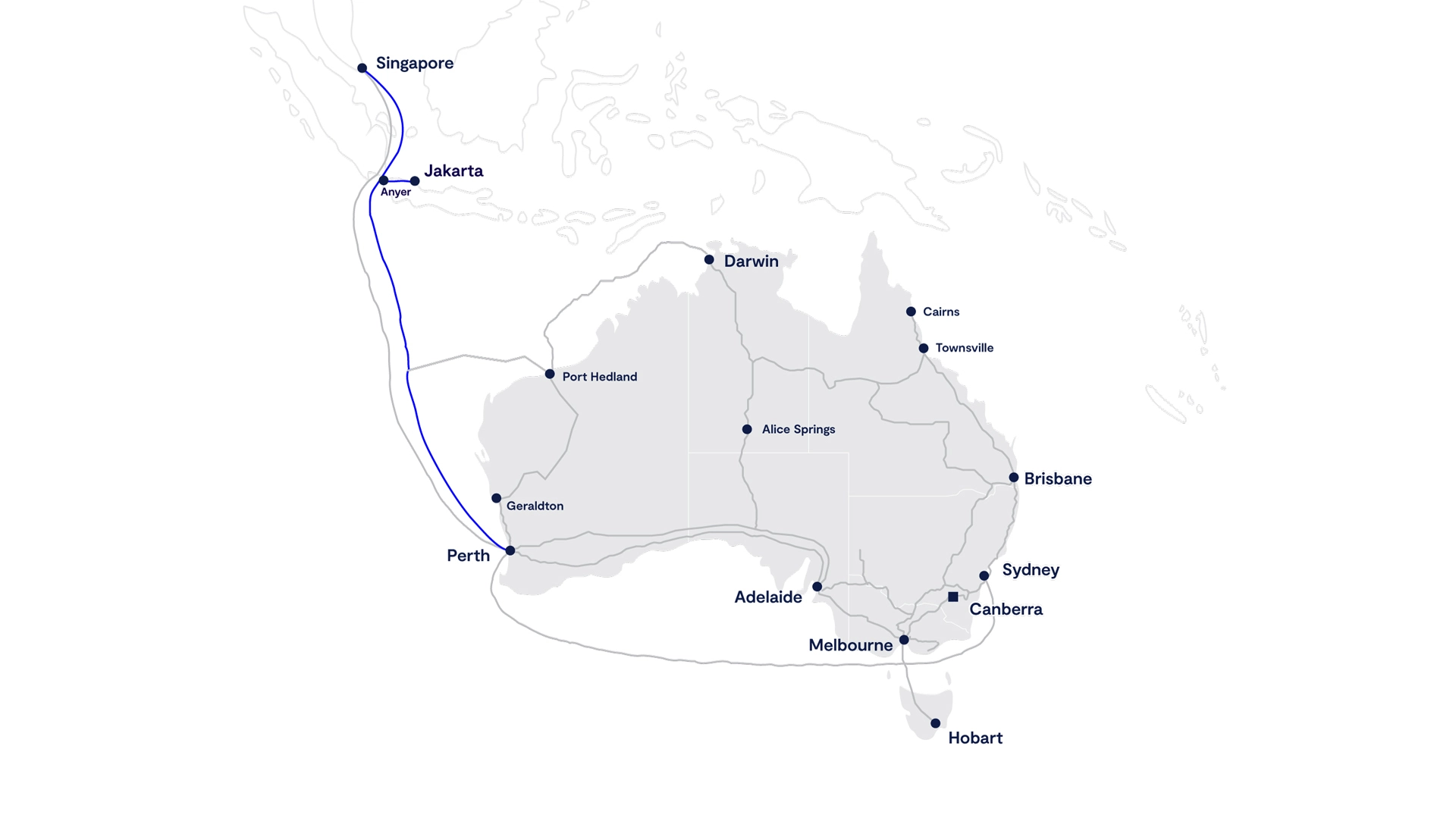
At 6:12am AEST on 4 September, the Australia-Singapore Cable (ASC), a 4,600 km subsea link connecting Perth to Singapore via Christmas Island and Indonesia, went dark on its Perth-Singapore section. Wavelength and Ethernet services dropped out. Internet traffic that normally took the shortest, lowest-latency path between Australia and Asia suddenly had nowhere to go. Early indicators of the faults were reported by ABC News on 11 August.
I’ve spent the past couple of weeks as part of the network testing effort helping get traffic moving again — running diagnostics, verifying rerouted paths and checking capacity as new links came online. It’s been a useful reminder of just how much invisible infrastructure sits beneath something as simple as loading a website. My contract work hasn’t been as glorious or in-depth as those working on cable ships or for Vocus themselves; so please don’t take my information as absolute authority on the subject.
There are 1.4 million km of telecommunications cables running along the seafloor, covering every ocean on the planet. Laid end to end, they would span the diameter of the Sun, and together they carry 99% of the world’s digital data. For something so vital, they’re surprisingly slender — often no more than 2cm in diameter.
Repairing one of these cables is nothing like calling out an electrician to come and splice two ends back together. It means locating both ends of a break kilometres underwater using a robotic submersible, a task that becomes far more complicated if the cable has been damaged in more than one place.
How bad did it get?
For most people, not very. Australian sites, local streaming and anything served from domestic content delivery networks kept working as normal. But for traffic that needed to reach Singapore, which a lot of Australian businesses use as an Asia-Pacific hosting hub because of its short network distance from Australia, the picture was different.
With the direct path gone, traffic had to go the long way around. One route we observed during testing sent data from Melbourne to Sydney, across the Pacific to San Jose, over to Tokyo, down to Hong Kong and finally into Singapore – turning what should have been a quick regional hop into a trip most of the way around the globe. That detour adds real latency, and it got worse because ASC wasn’t the only system down: INDIGO-West, another major Perth-Singapore route, was also experiencing an outage at the same time, stripping out a second path that would otherwise have absorbed some of the load. INDIGO-West is owned by Australia’s Academic and Research Network (AARNET), Google, Indosat Ooredoo, Singtel, Superloop and Telstra. ASC is solely owned by Vocus Communications.
Chasing the fault
Locating a subsea break isn’t instant. Vocus used COTDR (coherent optical time-domain reflectometry) testing from the Perth Cable Landing Station to narrow down the distance to the fault, with a dedicated testing window on 6 September that temporarily took Christmas Island services offline. Later testing from both the Perth and Singapore landing stations narrowed things further, placing the break in Indonesian waters between Anyer and Singapore, roughly 615 km from the Singapore end.
Getting a repair vessel out there isn’t quick either. It depends on Indonesian permits, confirming the right spare cable and equipment, and lining up a specialist marine repair partner and crew. In the meantime, the priority has been restoring capacity through other means: a path via Jakarta re-established Layer 2 Ethernet services relatively early on, and a new 100G route between Guam and Japan was brought online to take pressure off the Pacific detour.
Interestingly, ASC technically has repair priority under the relevant arrangements, but Vocus made the call to repair Indigo West first. Powering down ASC for its own repair would strip out the temporary Jakarta path and pile more load back onto the long-haul alternate routes – so restoring Indigo West first gives everyone breathing room before ASC goes fully offline for its fix. Current estimates have Indigo West back on 24 October and ASC repaired by 4 November, though subsea repair timelines are notoriously sensitive to weather, sea conditions and permitting.
What actually caused it?
This is where it gets more interesting. Subsea cable faults near Perth aren’t new – in 2021, ASC was cut in the Perth Submarine Cable Protection Zone about 10 km off City Beach, and the AFP later charged the master of the container ship Maersk Surabaya with negligent conduct under the Telecommunications Act, in what’s believed to be the first prosecution of its kind.
Given that history, it’s understandable attention has turned to shipping again. The chemical/oil tanker Gem Sapphire has been mentioned in connection with the latest fault, and the AFP is reportedly assessing a report after Vocus flagged fault signatures commonly associated with ship activity. The Gem Sapphire is a 183 m, ~50,000-DWT product tanker, I’d estimate each bow anchor at roughly 7-10 tonnes (7,000-10,000 kg), with perhaps ~8-9 tonnes as a reasonable estimate. The exact anchor specification isn’t publicly listed. Dropping an anchor like that would typically take 5-15 minutes once the crew begins paying out, depending heavily on anchoring depth and windlass operation. Retrieving would be roughly 15-40 minutes in moderate conditions, potentially much longer if the anchor is heavily set or the vessel is deep-water anchoring. The anchor chain would be a hefty piece of equipment: potentially several hundred metres and many tonnes. If it was dropped and hauled back up, it’s possible that it fell on the cable or hit it at some point during the process.
But a look at the Gem Sapphire‘s AIS telemetry doesn’t support a dragging-anchor story. Across seven anchored episodes near Perth, there’s no drag signature in the data, and swing-centre drift never exceeded 70 metres – consistent with a vessel sitting properly on its anchor, not fouling one along the seabed. Both anchorages sit around 3.4 km outside the protected cable zone.
There’s also a straightforward alternative explanation sitting in the weather record: a cold front crossed the area overnight on 7-8 August, with Rottnest Island recording gusts of 96 km/h (52 kt) from the south. The vessel’s movements – weighing anchor from an exposed position, standing off and re-anchoring once conditions cleared – read as ordinary seamanship in a gale rather than anything unusual. The fault itself wasn’t reported until 9 August, the day after, and the type of fault (shunt faults, consistent with insulation abrasion rather than a snag) doesn’t obviously point to an anchor strike either.
None of that rules anything out conclusively, but it’s a reminder that “ship was nearby” and “ship caused it” are two very different claims, and the AIS record here leans towards weather as at least as plausible a cause.
Faults like this are a useful, if disruptive, reminder of how much of the internet’s backbone runs through a relatively small number of physical cables sitting on the seabed, and how much redundancy and manual rerouting work happens behind the scenes when one of them goes down. With Indigo West and ASC both affected at once, this one required real coordination across multiple providers and countries to keep traffic moving with the least possible impact.
Specific actual close-up photographs of the underwater Australia-Singapore Cable (ASC) itself are proprietary, so minions like me won’t get to see any photos of damage unless Vocus chooses to release them.